
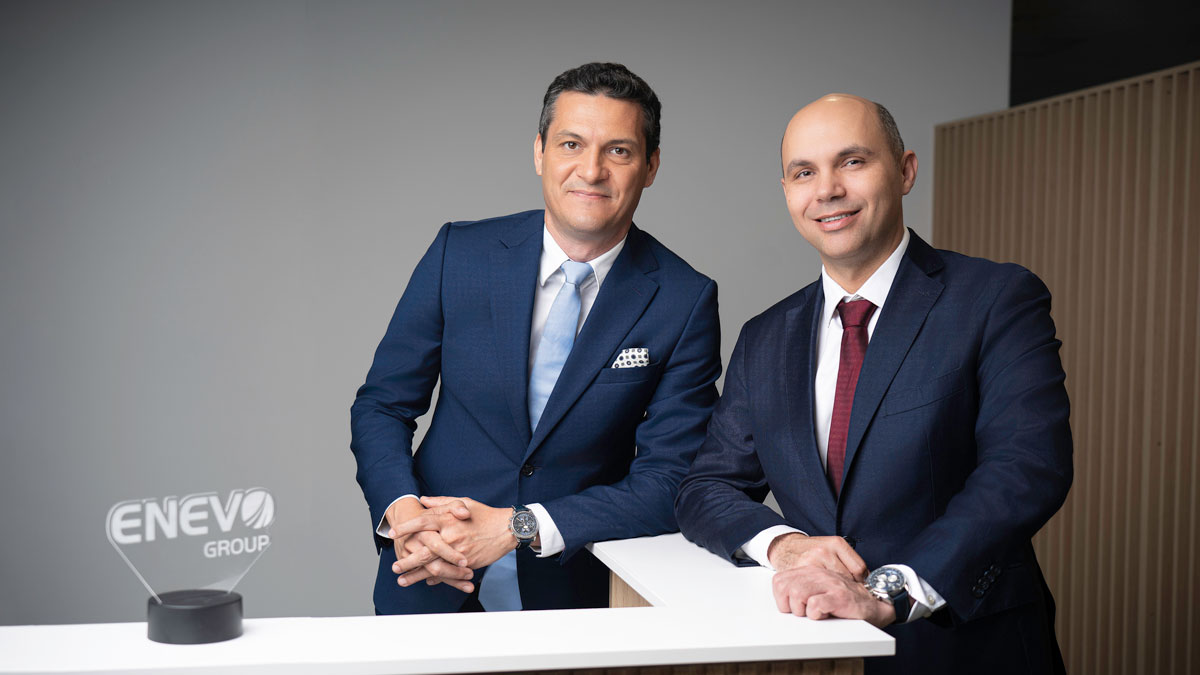
Cristian Pirvulescu – CEO & Radu Brasoveanu – CTO: ENEVO Group at the Forefront of the Technical Innovation in Clean Energy

In this interview with Cristian Pirvulescu, CEO, and Radu Brasoveanu, CTO at ENEVO Group, we delve into ENEVO’s remarkable journey, addressing the company’s most important milestones and its solutions to revolutionize the energy sector. They also emphasize the importance of strategic planning for the future.
ENEVO Group, an engineering company with 100% Romanian capital, was founded in 2014 with the mission of becoming a partner to major utilities in the fields of energy, digitalization, and cybersecurity. As a renowned technical supplier on 4 continents, in 12 countries, with 5 regional offices and around 160 professionals, the group provides innovative and unique solutions for industrial automation, power generation, transmission and distribution.
Cristian Pirvulescu is a Romanian entrepreneur and energy expert. As co-founder and CEO of ENEVO Group, Cristian built an international company having solid expertise as EPC Contractor for power generation, power transmission and distribution, automation and cybersecurity for critical infrastructures. Under his leadership, ENEVO grew business on 4 continents, with offices in Romania, Germany, the Kingdom of Saudi Arabia and the UK, working for the most prestigious utilities in the world. He carefully put together over the years young engineers and ambitious individuals who grew into a multidisciplinary team able to implement a wide range of digitalization and energy transition type of projects, encouraging the development and adoption of new technologies. From energy dispatch centres, energy efficiency projects, complex automation and smart grid applications to proprietary technology development for ensuring the cybersecurity of the power grid, the company became a market leader and a highly respected engineering partner.
Cristian Pirvulescu served as a member of the Supervisory Board of Transelectrica (Romania’s Transmission System Operator), Associate Professor with the Bucharest University of Economic Studies (MBA), Director of the Energy and Infrastructure Department of European League for Economic Cooperation and Director of the Aspen Institute Energy and Sustainability Program in Romania.
Radu Brasoveanu is a Romanian entrepreneur and energy expert with over two decades of experience in power generation, transmission, distribution, automation, and cybersecurity for critical infrastructure. As the co-founder and CEO of ENEVO Group, he led the company’s transformation from a startup into a globally recognized EPC Contractor, delivering complex energy and infrastructure projects across multiple continents. Under his leadership, ENEVO has expanded to over 250 employees, managing contracts valued at over €100 million and delivering impactful projects in power generation, renewable energy, and industrial automation for industry giants like Aramco, SABIC, and ArcelorMittal.
Before founding ENEVO, Radu Brasoveanu worked as a Senior Protection & Automation Engineer in Australia, where he led design teams for major substation projects for Electranet and SAPN. In Romania, he played a pivotal role as a Protection & SCADA Engineer, contributing to the first 61850 Process Bus Pilot Project and key projects for Transelectrica and CEZ.
First things first, we would like to learn more about ENEVO’s journey to becoming a world-known technical supplier. How did you manage to make a name for yourself on the world stage?
Cristian Pirvulescu: First thing first: by pragmatically targeting it. From the very beginning, we set out together to build a solid business that would go beyond national borders. Both of us had sufficient experience, both local and international. We were aware of the sector’s rigor, the criteria for bidding on projects, what was expected of us, and where we wanted to go. So, the first markets we entered were those where our services—as a new company—were in demand and could be sold.
When we talk about “markets,” we refer both to geography as well as to market segments and types of projects. When you start a business, as we did 11 years ago, you don’t have the shield of a well-known brand. All you can offer are your raw competencies—strong enough to convince both during the bidding and execution phases—and the desire to prove yourself. From the very beginning, we targeted more dynamic and diverse market segments. In Romania, the first wave of renewables was being built, and we were agile enough to secure a strong share in the market for automation systems in renewable plants, control systems, and dispatching.
For export, we managed to open a new geographic market that gave us those early opportunities: Saudi Arabia, where we signed several engineering contracts. And we delivered at the required parameters—perhaps a bit more, a bit faster, a bit better than expected. Since then, one project has led to another.
In Romania, we quickly became a well-recognized company in the electrical and automation fields, with a solid track record and references in both renewable energy and power transmission and distribution. In Saudi Arabia, we completed significant industrial projects that weren’t available on the European market at the time. These new references allowed us to move into projects across 12 countries, from South America, North Africa, Europe and up to Asia.




But none of this could have happened with ambition alone. You also need knowledge and capability. Radu Brasoveanu, the technical engine of the company, succeeded not only in building validated technical solutions, but also in forming highly competent, multidisciplinary teams—turning ENEVO Group into a true engineering school. Step by step, by combining the exceptional qualities of experienced colleagues with the eagerness to learn of young engineers, ENEVO Group managed to establish a reputation as an expert organization—one that develops not only projects but also human capital: specialists with the right mindset and the tenacity demanded by the international market. This decade-long journey would not have been possible without the unified team behind ENEVO Group.
And finally, I would mention the courage to enter new types of projects and to keep up with the pace of technology. The energy sector is undergoing a revolution, and we are proud that, after a decade, we are the front and centre when it comes to major regional renewable energy projects. We have an international reputation in automation for critical infrastructure, we’ve established solid partnerships with the most important technology suppliers, our client base includes some of the largest companies and utilities in the world, and our playing field is the global energy transition.
But perhaps the most important achievement—and the best proof of the exceptional capabilities cultivated at ENEVO Group—is that we’ve succeeded in developing proprietary technology in niche areas of the energy sector: our own software and platforms for dispatching and control, as well as for cybersecurity in critical infrastructures.
What are the most important milestones for ENEVO on this journey? What has been the basis for ENEVO’s growth, development, and reputation?
Cristian Pirvulescu: Just like in any solid structure, every single step has mattered in our journey. Each goal we’ve achieved has served as a foundation for the next phase of our growth. A particularly important period for us was between 2014 and 2016, when we built our expertise in renewable energy, automation, and control systems. It was during this time that we also secured our first major projects in Saudi Arabia, including substation rehabilitations and large-scale projects for major industrial players like SABIC and its affiliates.
As we progressed, we took on increasingly complex automation projects, eventually working on large power plants. By 2018, we completed our first significant hydropower projects. Alongside our work in Saudi Arabia, we began expanding into new markets such as Uruguay, Morocco, and Bahrain. A key milestone came in 2019 when we were awarded the substation project in the Kuwait Joint Operation (KJO) Area, a major reference with the Saudi Electricity Company (SEC)—one of the most dynamic utilities globally. The COVID-19 pandemic also shaped us as an organization. Despite the challenges, we kept our projects running and matured operationally, especially on international fronts. In Romania, we ramped up quickly—commissioning over 400 MW in less than a year as a general contractor. Today, we are working on over 1 GW of projects, covering a diverse portfolio that spans solar, wind, and storage across multiple European markets.
Radu Brasoveanu: ENEVO Group’s growth has been fuelled by our technological adaptability and a commitment to technical excellence. Our team has developed strong capabilities across a wide range of projects, working with clients in multiple sectors, on various platforms, and using diverse technologies. This has helped us foster an engineering culture that’s flexible and vendor independent.
We’ve always embraced innovation and continuous learning, applying the best practices in every project. And we never shied away from new technologies or tough challenges. Every project we’ve undertaken was approached with engineering discipline and a determination to overcome any hurdle.

What are the most valuable lessons learned from international experience?
Radu Brasoveanu: That’s a great question—because, in theory, a substation, a photovoltaic plant, or an energy storage system should function similarly regardless of geography. But what we’ve learned from our international projects is that there’s always something new to discover. Yes, the laws of physics are universal, but standards, industries, and especially business ecosystems vary greatly from one country to another.
We’ve learned a lot from our clients, and we genuinely enjoy the challenges they bring to the table. I’ve overseen ENEVO Group’s technical operations from Europe to Uruguay, North Africa, and the Middle East, and every new client interaction brings a sense of fulfilment. Each project adds to our practical experience.
First, you must understand local laws and regulations. Utilities, for instance, are often large, highly standardized organizations. Frequently, equipment we’ve used successfully in other projects can’t be implemented because it lacks local certification—this forces us to build a wide range of qualifications. Also, in brownfield projects, you often have to integrate with legacy systems from previous generations. This requires meticulous engineering and an openness to quickly learn unfamiliar technologies—many of which you may never encounter again.
Each market also has its own commercial rules. Over time, you learn that there are no universally “good” or “bad” models—whether technical, commercial, or organizational—but only models tailored to local realities. And, just as importantly, you must understand and respect cultural differences. I can confidently say that every international project has helped us grow—not only technically, but also in terms of human and organizational maturity. Our extensive client base, from prosumers to the world’s largest energy companies, has provided lessons no book could teach.
Before I close, I want to emphasize one more thing: our international projects haven’t just expanded our footprint—they’ve transformed ENEVO Group into a truly multinational company from within. We’ve met exceptional people along the way, and today we’re proud to have a team of over 350 employees representing more than 15 nationalities. More than half of our internal meetings are conducted in English, and this multicultural dynamic brings a special energy to everything we do.
What services does ENEVO offer for the energy sector? What key services does the company offer for Romania? How about for foreign markets?
Cristian Pirvulescu: In recent years, ENEVO Group has experienced a remarkable growth trajectory. We are now in our 5th consecutive year of accelerated expansion across all areas of our business. Today, ENEVO Group is probably the largest general contractor with 100% Romanian capital operating in the renewable energy sector—fully equipped to handle every stage of power plant development, from design and equipment supply to construction, grid connection, and energy evacuation. This rapid growth has also driven the need to strengthen our corporate structure by creating specialized departments and divisions that align with the demands of the markets we serve:
- Renewable Energy Division – provides end-to-end services including design, equipment delivery, construction, and commissioning of renewable power plants and energy storage systems.
- Power Transmission & Distribution Division – focuses on the execution of electrical substations up to 400kV as a general contractor.
- Automation Division – a multidisciplinary team delivering design, manufacturing of automation cabinets, configuration of hardware and software, testing, and commissioning of control, protection, SCADA and DCS systems, both for the energy sector and other industrial applications.
As part of our diversification strategy, we’ve also expanded into post-EPC services. We now offer 24/7 dispatching services and operations and maintenance (O&M) for power plants and energy infrastructure. More recently, we’ve added electricity supply services to our portfolio, giving clients a comprehensive, one-stop-shop for both technical and commercial operations.
A key differentiator in our operations and monitoring capabilities is our Security Operations Centre (SOC). ENEVO Group has launched SENTRYOT, a specialized product for control and protection systems in both the energy and process industries. SENTRYOT enhances the highly specialized landscape of industrial cybersecurity with a globally unique set of operational features. It also directly supports compliance with the NIS 2 Directive, which becomes mandatory for critical infrastructure operators starting January 1, 2025.

How does ENEVO respond to market challenges in general and what does it do for its customers? What is the role of innovation and R&D in market evolution?
Radu Brasoveanu: We’ve all been hearing the term “Energy Transition” for years now. At first, some saw it as an opportunity, while others were sceptical, viewing it as a political or economic initiative with uncertain prospects. But today, I believe the transition is no longer a concept in progress; it’s already happened. The energy sector has fundamentally reshaped itself.
Fifteen years ago, few of us would have imagined, as we learned about emerging renewable technologies in just a handful of international courses, that these technologies would mature so rapidly—and come to surpass and even dominate traditional energy sources. The numbers speak for themselves: the total installed capacity of photovoltaic solar energy in the European Union has doubled in just three years, from around 164 GW in 2021 to 338 GW in 2024. In fact, solar energy surpassed coal-generated electricity in the EU in 2024, and renewables now account for half of the European Union’s electricity production.
This transition has been driven by major investments in research and development, leading to advanced technologies that have helped reduce costs and improve the efficiency of renewable sources.
In this dynamic context, a wide range of new needs have emerged—needs that ENEVO Group is actively addressing. First and foremost is the demand for experienced contractors to build renewable power plants. Today, we have both the capabilities and references required to deliver large-scale and even utility-scale turnkey projects.
There’s also a growing need to expand transmission and distribution infrastructure—an area where ENEVO Group plays an active role. But perhaps the most critical challenge is the need for digitalization, automation, and efficient operation—all essential to prevent crises or catastrophic failures in the grid.
The energy transition has made the power grid much more complex. In this regard, what specific solutions does ENEVO propose to address the challenges related to renewable energy sources and smart grids? What is the key differentiator recommended by ENEVO for this segment?
Cristian Pîrvulescu: As much as we would like perfect alignment, the pace of renewable energy development is far outpacing the slower evolution of transmission and distribution networks. Until new interconnections and high-capacity grid infrastructure are built, digitalization and automated control remain the only viable tools for ensuring safe and efficient technical and commercial operation. In this space, ENEVO Group offers some of the most advanced solutions for grid regulation, automation, monitoring, and dispatching.
Another area where ENEVO Group has made significant strides is energy storage. We’ve already secured a strong portfolio of storage projects and are actively involved in multiple international initiatives. In addition to building solid partnerships with leading technology providers, we’re also developing our own advanced systems for control, communication, and energy management—tools that enable seamless integration of new plants into the grid, while supporting commercial operation through automated integration of consumption and renewable generation forecasts.
Our ambition is to become a global EPC player in the energy storage market, while also delivering customized, end-to-end solutions for automation and asset management.
Of course, any discussion about smart grids and digitalization would be incomplete without addressing cybersecurity. Most command and control systems in the energy sector remain highly vulnerable to attacks. Legacy technologies, poor cybersecurity hygiene during initial infrastructure deployment, and the potential cascading effects of a cyberattack across the energy value chain all demand new approaches—ones that ENEVO Group is ready to lead.
In addition to our specialized auditing services for critical infrastructure, we’ve developed proprietary products—most notably SENTRYOT. This next-generation OT cybersecurity platform is designed to protect and fortify the world’s critical infrastructure. SENTRYOT brings clarity to a fragmented cybersecurity landscape by correlating operational and security data and enabling hybrid teams to respond quickly to threats. It provides full OT visibility, the ability to stop threats before they impact operations, and built-in support for NIS 2 Directive compliance—mandatory for essential and critical infrastructure operators starting January 1, 2025. SENTRYOT turns complexity into actionable insight.

What role does the experience gained so far in the energy infrastructure sector play in identifying cybersecurity solutions?
Cristian Pirvulescu: We didn’t come from the IT world, and we’re not a cybersecurity company. Our involvement in OT (Operational Technology) cybersecurity emerged naturally from the practical needs we identified in our automation projects and through direct dialogue with utilities and end users. The value our products bring—and the strong relationships we’ve built with utilities worldwide—are largely rooted in our deep understanding of operational processes.
Working with critical systems—where not all information is always available, and where the top priority is to keep operations running—requires deep technical confidence. We don’t do cybersecurity to add complexity or introduce new vulnerabilities. We do it to provide visibility, traceability, and correlation where existing technologies fall short.
We’ve deployed automation systems, SCADA, and protection systems for substations and energy control centres—and now, with our in-depth technical knowledge of how these systems operate, we’re also securing them from a cybersecurity standpoint.
In how many markets does ENEVO operate in this segment, and how competitive is it?
Cristian Pîrvulescu: The solutions we offer are globally unique. We are confident that we’re at the forefront of technological innovation in this critical field. Since the end of last year, when we launched the first Proof of Concept for SENTRYOT, discussions have advanced significantly—and we believe we’ve already been validated by some of the world’s most prominent utilities.
We continue to develop and integrate our platform in collaboration with other technology providers, as well as with major companies across various sectors: electric power, oil and gas, manufacturing, ports, and more.
Strategic planning seeks to anticipate future industry trends. Based on international experience and analysing domestic market requirements, what trends do you think we can expect?
Cristian Pîrvulescu: Renewable energy sources democratized and decentralized electricity, moving generation closer and closer to the consumer, and this comes with some serious technical challenges for the grid, but also with great opportunities. Also, renewables and battery storage solutions are a great mix, with a potential to both solve some of those grid challenges and contribute to its flexibility and resilience, so we will see more and more large-scale Hybrid Power Plants in the future.
This all generates an increase in the need to have real time visibility at all grid levels, an increase in aggregation of energy sources, an increase in specialized technical services. This means more sophisticated control systems, but also more advanced energy trading strategies, that also require a high degree of automation. We already have the engineering know-how and the technical and commercial capabilities in place to play our part in what comes next for the energy sector.
How is ENEVO preparing for the future?
Radu Brasoveanu: In the immediate and more concrete term, we’re actively diversifying our service portfolio. We’ve recently launched OMNI SOC, our 24/7 Energy and Cybersecurity Dispatch Centre, and ENEVO Power, through which we now offer energy trading services—both built on our unique mix of robust and forward-looking technologies.
We’re also exploring how to securely integrate AI into both our internal operations and the solutions we deliver to clients—from SCADA operator assistance to renewable energy production forecasting, to streamlined condition monitoring tools.
At the same time, we continue to uphold our “engineering school” ethos. I believe we have one of the youngest teams in the industry—certainly in Romania. Some of the young talents we brought on board 7–8 years ago, while they were still university students, are now senior engineers in key management roles. We fully intend to continue growing this way.
Cristian Pirvulescu: Long term, our strategy is structured around three essential directions, designed to keep ENEVO Group at the forefront of the energy and smart automation industries.
First, we want to expand our renewable energy portfolio, through the development of photovoltaic projects and energy storage systems (BESS). This growth will further solidify our position as a leader in the clean energy transition, both locally and internationally.
Second strategic pilar is the development of an intelligent and secure infrastructure, with a focus on extending the SENTRYOT platform to protect critical energy infrastructure. These technologies are vital for the safe and efficient integration of renewable energy into modern power grids.
Third, we will accelerate our international expansion, by strengthening our presence in Western and Eastern Europe as well as the Middle East, while reinforcing both local and international teams.
Through these three pillars, ENEVO Group aims to play a strategic, active role in the global energy transition—delivering innovative and sustainable solutions to meet the energy challenges of the future.