
Offshore Wind Power: North Sea – the World’s Largest Clean Energy Centre
Romania, in a Continuous Stand-by

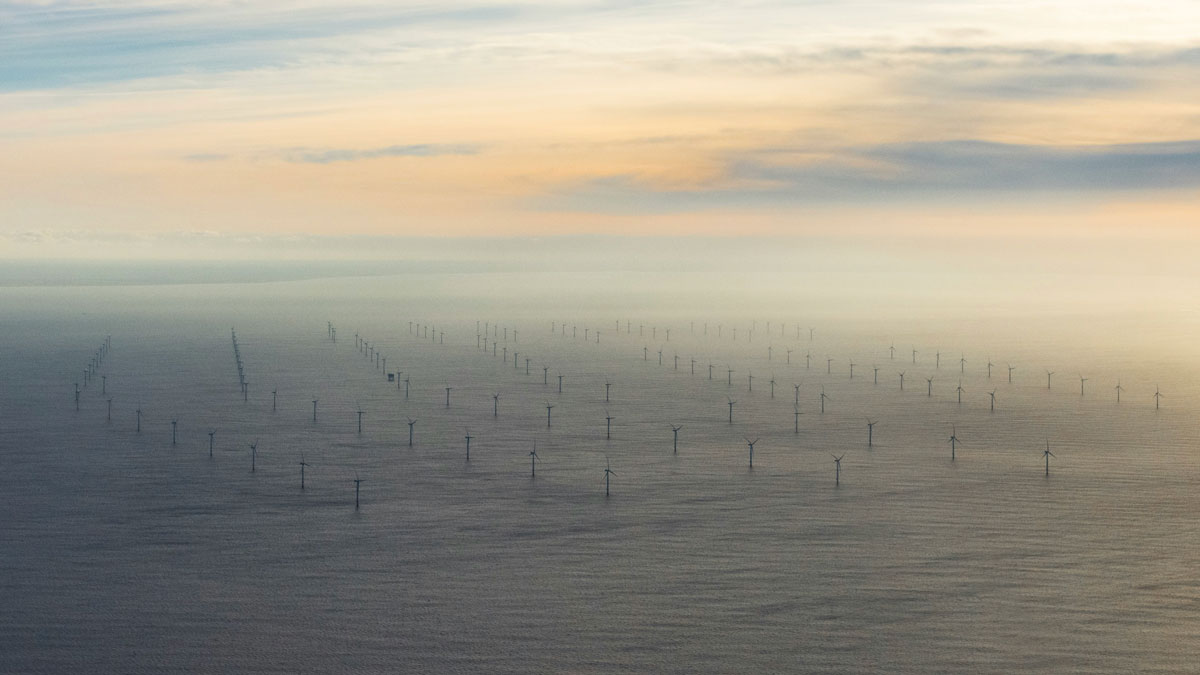
Wind power in the EU has gained ground, especially after Ukraine’s invasion of 2022. Wind farms have proliferated in the North Sea, but neighboring countries want to go even further in energy cooperation. In contrast, in the Black Sea, although the World Bank rates Romania as having significant wind power potential, analysts said at the end of last year that it is unlikely that any offshore turbines will be built anytime soon. The causes are more likely to be related to certain bottlenecks.
EU 2025: Electricity generation from wind and solar has overtaken fossil fuels
Last year, electricity production from wind and solar power—two low-carbon sources—surpassed that from fossil fuels (gas, coal, and, to a lesser extent, oil) in the EU. Wind turbines and photovoltaic panels supplied 30% of the Union’s energy, compared with 29% for oil, gas and coal, according to the latest data from the European Electricity Review, published on January 22.
Unprecedented fleet of offshore wind farms in the North Sea
In Hamburg, leaders from nine European countries announced their commitment to developing an “unprecedented” fleet of offshore wind farms. Amid heightened international tensions and increased threats to energy supplies and infrastructure, the ministers of economy from nine North Sea coastal states (Belgium, Denmark, France, Germany, Ireland, Luxembourg, the Netherlands, Norway, and the United Kingdom) met in Hamburg on January 26. There, they reaffirmed the goal set in 2022 at the first summit: to accelerate the development of offshore wind energy capacity to reduce Europe’s dependence on Russian energy.
This announcement coincides with the adoption by the 27 Member States of the regulation on the phasing out of imports of pipeline gas and liquefied natural gas (LNG) from Russia into the EU. The long-term goal is to have 300 gigawatts (GW) of offshore wind farm capacity in Europe by 2050, making it the world’s leading offshore energy hub. The North Sea, characterized by shallow waters and constant winds, is considered the cradle of offshore wind power and a highly strategic location. Wind power is therefore becoming a pillar of European energy independence.
“Investment Pact” signed by governments, industry and TSOs
The Hamburg Declaration marks a historic commitment. For the first time, wind farms are being planned jointly in several European countries. The resulting electricity generation will power nearly 100 million homes.
To support this momentum, the ambitious plan to accelerate offshore wind energy in the North Sea is backed by an “investment pact.” Signed by governments, industry and transmission system operators (TSOs), the pact aims to ensure the deployment of new capacity between 2031 and 2040, with a target rate of 15 GW installed per year.

Valued at EUR 9.5bn, it plans to make the North Sea “the world’s largest reservoir of clean energy” and mobilize EUR 1 trillion in capital in Europe. It is also expected to create more than 90,000 jobs and cut electricity production costs by 30% over the next 15 years.
Strategic issues, ever present
The industrial issue is also central to the concerns. Wind energy is attractive both for its increased security of supply and for the proximity of production sites to the main industrial centers in Northern Europe. For the EU, offshore wind is one of the most effective levers to achieve its decarbonization ambitions.
At the same time, promoting the “Made in Europe” concept is increasingly becoming a strategic priority in the offshore wind energy debate. The Old Continent has indeed an integrated and highly efficient industrial base in this sector.
Countries bordering the North Sea are also trying to raise the profile of their industries, amid allegations of sabotage and espionage in the region blamed on Russia. This is why NATO, which always keeps a close eye on the situation in the region, was represented at the Hamburg summit.
The situation in Romania
Although the World Bank shows that Romania has wind power potential of between 76 and 94 GW in the Black Sea, the construction of an offshore turbine is still a long way off.
In 2024, Romania adopted a law regulating the exploitation of offshore wind energy in the Black Sea, and in April of the following year, it launched a public appeal to companies, consortia, and experts interested in conducting a strategic study to identify areas in the Black Sea that could become future concession areas for offshore wind energy production. Unfortunately, not many companies were eager to carry out the study.
A World Bank report on Romanian wind energy in the Black Sea, released in September 2024, shows that investments of up to EUR 19 billion could be made by 2035 in the Romanian Black Sea area.
Starting in June 2024, Law 121 on offshore wind energy became effective in Romania. The law lays down deadlines for identifying the blocks to be concessioned, for issuing regulations, for drawing up a support scheme and for setting fees. These deadlines have not been met and delays have been recorded.
The Romanian government had to approve, by March 31, 2025, based on a specialized study, the list of offshore wind farm blocks that can be leased. The procedures for the specialized study had to be initiated within three months of the entry into force of the law on offshore wind energy.
Delays including in drafting regulations
Law 121 stipulates that specific rules had to be approved on the procedures for the concession of offshore wind blocks, the amount of royalties and fees, as well as the support scheme, by June 30, 2025. After this law was passed, the subject of wind turbines in the Black Sea was not included in the discourse of the ruling parties. Nor is it of interest to those in opposition.
It was only in May 2025, almost a year after the law was published, that the Ministry of Energy began the process of conducting a study to identify and delimit the blocks in the Black Sea that could be leased for the development of offshore wind farms. This study will form the basis for strategic decisions on the concession of offshore blocks and will provide investors with a clear, scientifically based vision.
USR MP and Vice-Chair of the Chamber of Deputies’ Committee for Industry and Services, Cristina Pruna, explained that although it will soon be two years since the adoption of the Offshore Wind Energy Law, progress has been made, but too little. “Many of the deadlines laid down in the law have not been respected. Last year, I sent a question on the state of progress of a critical study to establish the perimeters, which was already overdue. Now, a year later, I will resume this endeavor, because its status and that of several pieces of secondary legislation that have not yet been adopted are still unknown. It is important that these delays are quickly made up for.”
Romania was already lagging behind in 2024 in offshore wind power compared to most European countries that have access to this resource and already have a tradition of exploiting it, Cristina Pruna pointed out. “Unfortunately, this resource has been treated as something of secondary importance by most decision-makers. First, a bill that I submitted based on best practices from other countries and following numerous debates with specialists in the field was postponed, and then many of its key provisions were included in another bill proposed by the political power at that time. The problem is that two more years have been lost, we have reached 2024, and here we are, two years later, still without a clear timeline for when the actual bidding for offshore perimeters will begin, let alone when the construction of offshore wind farms will start. I believe that when discussing the Black Sea, even though commercial exploitation of natural gas resources receives the most attention, it is important not to overlook the potential of offshore wind power. Every energy resource is important for us as a country to have as diversified an energy mix as possible. Other European countries do not even have access to the sea, and we, as a state, are not capitalizing on the offshore wind energy potential that we enjoy.”
Offshore in the Black Sea, important, but only on paper…
Assessments carried out by the World Bank/ESMAP and WindEurope indicated a conservatively estimated technical potential of 60–76 GW, part of which is intended for fixed foundations in shallower waters (less than 60 m) and the rest for floating platforms.
A legislative framework dedicated to offshore wind energy was discussed in 2023-2024 and according to the Ministry of Energy was a priority for 2025. The aim was to clarify institutional roles (Ministry of Energy, ANRE, NAMR, maritime authorities), the method of granting concessions, environmental requirements, and connection to the national grid. It should be noted that Transelectrica includes in its development plans scenarios for transporting energy from potential offshore nodes to Dobrogea and then to internal 400 kV axes and interconnections.
Cristina Pruna addressed several questions to the Ministry of Energy, registered with the Chamber of Deputies, concerning the status of compliance with legal obligations for the implementation of the provisions of Law No. 121/2024 on:
- Status of compliance with the obligation to adopt the Government Decision provided for in Article 45(1) of Law 121/2024
The Ministry of Energy initiated the Government Decision amending and supplementing the Government Decision no. 316/2021 on the organization and functioning of the Ministry of Energy. The draft government decision was put up for public debate on the ministry’s website on February 28, 2025, and is currently registered with the CES on April 28, 2025, with the interministerial and governmental approval procedure underway.
- Status of fulfillment of the obligation to initiate procedures for conducting the specialized study provided for in Article 6, paragraph 1 of Law 121/2024
The US State Department provided support to Romania during both the first stage of developing the offshore law and the second stage, with an emphasis on establishing marine concession areas. In January 2025, US aid to all countries, including Romania, was suspended for a minimum of 80 days, which is why the project involving DOS has also been suspended for an indefinite period. However, prior to this unfortunate event, the Ministry of Energy had submitted a request for technical support for the development of offshore wind energy in the Black Sea.
On April 3, 2025, by Order 274 of the Secretariat General of the Government, the draft initiated by the Ministry of Energy, support for the development of regulations for the concession of marine areas for the development of offshore wind farms in the Black Sea area, was included in the official list of selected projects proposed by the Romanian authorities under the technical support instrument, receiving approval through the European Commission’s implementation decision on the financing of the technical support instrument and the adoption of the work program for 2025. Currently, with the help of the World Bank, a consultant within TSI, efforts are being made to develop secondary legislation following the implementation of Law No. 121/2024 on offshore wind energy.
Two scenarios from the World Bank Report on Romanian wind energy in the Black Sea
- Low-growth scenario: Aims for 150 turbines installed through five projects by 2035. The value of the investment would amount to EUR 9 billion, installed capacity of 3 GW, which will provide 16% of the country’s energy needs.
- Intensive growth scenario: Aims for 360 turbines installed through seven projects by 2035. The investment will be worth approximately EUR 19 billion, with an installed capacity of 7 GW, which will cover 37% of the country’s energy needs.
Romania risks missing strategic, economic and industrial opportunities
Romania has enormous offshore wind energy potential in the Black Sea, estimated at between 60 and 94 GW, enough to contribute significantly to the national energy mix and decarbonization targets. However, the practical development of this sector is stagnating, largely due to legislative and administrative delays. The deadlines set out in Law 121/2024 for identifying concession perimeters, drafting concession rules, and establishing support schemes have not been met, and there is no clear timeline for offshore project auctions.
Meanwhile, neighboring states and other European countries are taking advantage of the strategic and industrial benefits of their resources. In the North Sea, EU countries have planned and heavily financed offshore wind fleets to ensure their energy independence and boost local industry.
Thus, Romania risks falling behind other countries in harnessing offshore wind energy, missing out on strategic, economic, and industrial opportunities, even though the geographical potential and natural resources exist.
The current delay is transforming offshore wind energy from a promising resource into a missed opportunity in the medium term.