
A New Siemens Digital Factory in Romania: Zero Carbon Emissions and Data-driven Processes

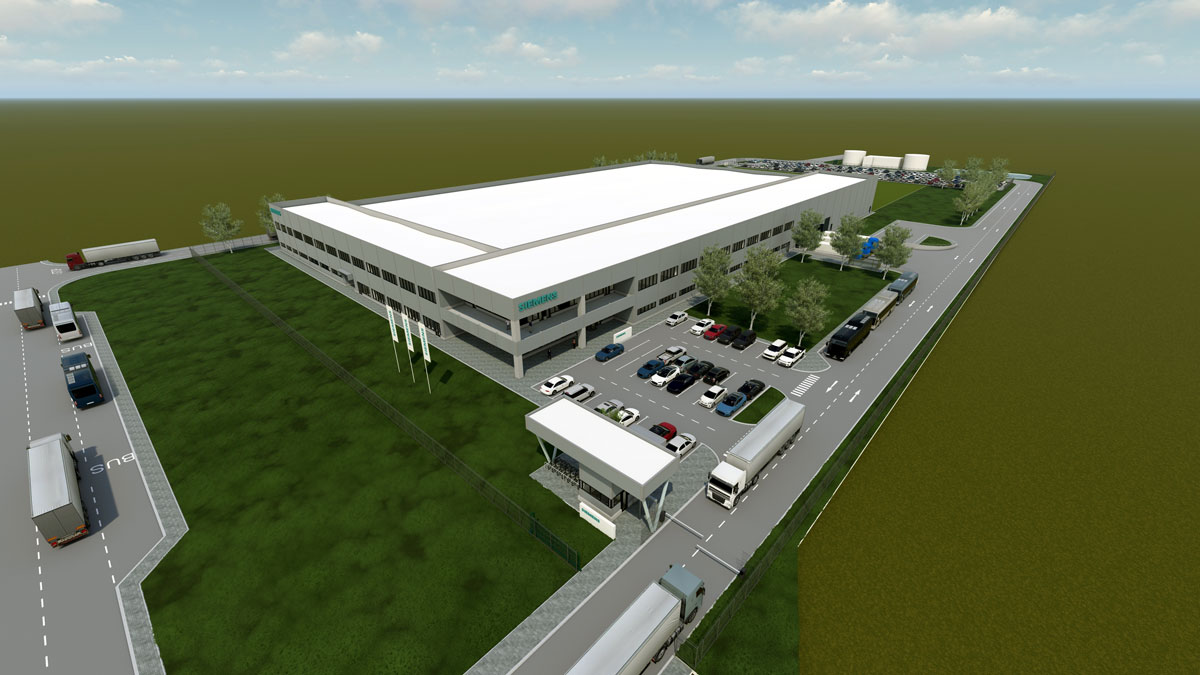
Siemens plans to build a new digital factory from the ground up in the western industrial zone of Sibiu. The planned investment, worth several tens of millions of euros, is intended for a separate Siemens business unit with a specific product portfolio and its own operational footprint, and is unrelated to other manufacturing activities. This investment reflects a long-term industrial strategy targeting specific market segments.
Construction is scheduled to begin in August 2026 and is expected to be completed by 2028, following receipt of all necessary permits and approvals. The planned new facility will cover an area of approximately 14,500 m² and will be developed in partnership with WDP under a long-term lease agreement, in full compliance with local laws and regulations.
Built on Siemens technology, designed for the future
The planned factory in Sibiu is designed to be a data-driven production environment, built using Siemens’ proprietary technologies and solutions. Prior to construction, the production area is expected to be virtually designed using Siemens Digital Twin technology—enabling the precise simulation and optimization of equipment layouts, workflows, and production processes to determine the best possible configuration.
The portfolio to be available at the new factory will include the SENTRON low-voltage product range, designed for protection, switching, measurement, and monitoring (such as miniature circuit breakers, residual current circuit breakers, residual current circuit breakers with overcurrent protection, and electronic circuit protection devices), for industrial and residential use.
Highly flexible production powered by artificial intelligence
Siemens is planning for smart and highly flexible manufacturing, in which artificial intelligence will play an increasingly important role. The focus will be on seamless data integration and intelligent control, from raw material procurement through assembly and testing to final delivery. Automated guided vehicles (AGVs) will transport materials to the production lines completely autonomously. The integration of automation and robotics is also part of the strategy.
In addition to increased efficiency, Siemens also expects greater flexibility, enabling rapid responses to changing conditions and meeting future customer requirements.



Designed to be carbon-neutral
Sustainability is set to be a central element in how this factory is built and operates. The facility is designed to operate on a carbon-neutral basis, with energy efficiency integrated into all manufacturing processes. Skylights equipped with tubular daylighting devices are planned to channel natural sunlight directly into the production area through highly reflective tubes, reducing reliance on artificial lighting. Upon completion, a rooftop photovoltaic system is planned for installation; the solar energy produced on-site will be used directly, and the remaining electricity will be purchased from sustainable suppliers.
A workspace designed for people and progress
The factory is designed as an ergonomic and digitally connected workspace, created to foster collaboration and continuous learning. There are dedicated spaces for professional training, designed to help employees develop skills in automation, data analysis, and continuous professional development. The modern offices and common areas are also designed to ensure full accessibility, including for people with disabilities or limited mobility.